
Talk to us
08045816043
Talk to us
08045816043
Technical Specification
|
Usage |
Industrial |
|
Physical State |
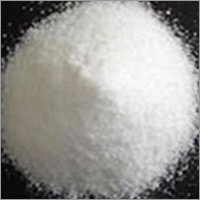
Powder |
|
Grade Standard |
Technical Grade |
|
State of Matter |
Granular |
|
Packaging Type |
Bag |
|
Form of Chemicals |
Solid |
|
Packaging Size |
25 KG Bag |
|
Color |
White Crystal |
Applications Across Diverse Industries
Polyelectrolytes have a wide range of applications across industrial, municipal, and commercial water-treatment processes. They are used wherever efficient particle aggregation and solid-liquid separation are required.
Common applications include:
Polyelectrolytes can significantly improve the efficiency of downstream sedimentation, filtration, and dewatering operations when the appropriate polymer grade and dosage are selected.
Polyelectrolytes for Color Removal
Specially selected polyelectrolyte-based treatment products are also used in textile, dye, and pigment industries for the treatment of colored wastewater. These polymers can assist in aggregating color-causing substances and suspended particles, making them easier to separate from the treated water.
The effectiveness of a polymer depends heavily on wastewater chemistry, dye characteristics, pH, temperature, and the presence of other treatment chemicals. Therefore, application-specific testing is recommended before selecting a product for full-scale treatment.
Selecting the Right Polyelectrolyte
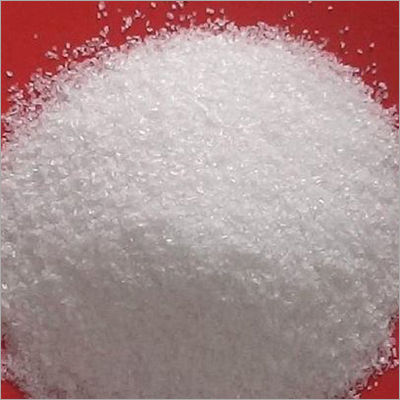
Although most dry polyelectrolytes may appear similar, the appearance of the powder alone cannot determine whether a particular polymer is suitable for a specific application. Most commercial products are supplied as white or off-white powders or granules, despite having significantly different molecular weights, charge densities, and performance characteristics.
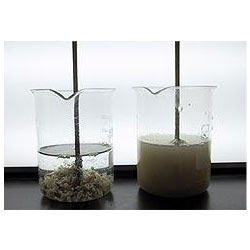
The most reliable way to identify the appropriate polymer is through laboratory jar testing or application-specific performance testing. A proper evaluation can help determine:
The dosage of polyelectrolyte is often more important than the price per kilogram of the product. A lower-priced polymer may not necessarily provide the lowest overall treatment cost if it requires a higher dosage or delivers inferior performance.
Conversely, a higher-quality polymer that performs effectively at a lower dosage can potentially reduce total chemical consumption and operating costs. For this reason, product selection should be based on cost per unit of treatment and overall performance, rather than purchase price alone.
Superior Flocculation and Solid-Liquid Separation
Polyelectrolytes improve the aggregation of fine suspended and colloidal particles, producing larger flocs that can be separated more efficiently. This can enhance sedimentation, clarification, filtration, sludge thickening, and mechanical dewatering.
Their effectiveness makes them an important component of modern water and wastewater-treatment systems, particularly where high levels of suspended solids or difficult-to-settle particles are present.
Convenient Physical Form and Handling
Most dry polyelectrolytes are supplied as white or off-white powder or granular materials. They are generally easy to transport and store when protected from moisture and contamination.
For use, the polymer is typically prepared as a dilute solution in clean water and then dosed into the treatment system using suitable dosing equipment. Preparation and hydration conditions should be optimized according to the specific polymer grade to achieve maximum performance.
Frequently Asked Questions (FAQs) About Polyelectrolytes
Q1. What are polyelectrolytes and what are they used for?
Polyelectrolytes are polymers used primarily as flocculating and conditioning agents in water and wastewater treatment. They promote the aggregation of suspended and colloidal particles, improving sedimentation, clarification, filtration, sludge thickening, and dewatering.
Q2. What are the main types of polyelectrolytes?
Polyelectrolytes are commonly classified according to their ionic characteristics as:
They can also be differentiated according to molecular weight and charge density. The appropriate type depends on the characteristics of the wastewater, sludge, or process stream.
Q3. What are Dewatering Polyelectrolytes (DWPE)?
Dewatering Polyelectrolytes, commonly abbreviated as DWPE, are polymer grades selected specifically to improve the dewatering of sludge. They are used with equipment such as decanter centrifuges, belt filter presses, and filter presses to promote floc formation and improve water release from sludge.
Q4. What are De-Oiling Polyelectrolytes (DOPE)?
Certain polyelectrolyte formulations are used in de-oiling applications to assist with the separation of oil, suspended solids, and water. Such products are selected according to the characteristics of the oily wastewater and the required separation process.
Q5. How is the correct polyelectrolyte selected?
The correct polymer should be selected based on factors such as wastewater chemistry, suspended-solids characteristics, pH, ionic strength, molecular weight, charge density, sludge type, and treatment objectives.
Because different polymers can look very similar, visual inspection is not sufficient for product selection. Jar testing or laboratory performance testing is recommended to identify the most suitable polymer and dosage.
Q6. Why is polyelectrolyte dosage so important?
Dosage directly affects floc formation, settling, clarification, and dewatering performance. Underdosing may result in incomplete particle aggregation, while excessive dosing can also negatively affect treatment performance and increase chemical costs.
Therefore, the optimum dosage should be determined through controlled testing rather than relying solely on a standard dosage.
Q7. How are polyelectrolytes prepared before application?
Dry polyelectrolyte powder is generally added gradually to clean water while using gentle agitation to ensure proper dispersion and hydration. Excessive shear should be avoided because it may affect polymer performance.
The required preparation concentration and maturation time vary according to the polymer grade and application. The manufacturer's technical recommendations should be followed.
Q8. Where are polyelectrolytes commonly used?
Polyelectrolytes are widely used in ETPs, STPs, mining facilities, paper mills, textile industries, oil-treatment systems, chemical-processing plants, sludge-dewatering facilities, and water-recycling systems.
Q9. Can polyelectrolytes be used for textile color removal?
Yes, appropriately selected polymer-based treatment products can be used in textile, dye, and pigment wastewater treatment to assist in the aggregation and separation of color-causing compounds and suspended matter. The optimum product and treatment conditions should be determined through application-specific testing.
Q10. Is the cheapest polyelectrolyte always the most economical option?
No. The purchase price per kilogram does not necessarily represent the actual treatment cost. A polymer that costs more per kilogram may require significantly less product to achieve the desired result.
The better comparison is generally based on cost per unit of wastewater or sludge treated, together with treatment efficiency, sludge characteristics, equipment performance, and overall operating costs.
Why Choose the Right Polyelectrolyte?
Selecting the right polyelectrolyte is essential for achieving efficient flocculation, clarification, sludge dewatering, de-oiling, and solid-liquid separation. Since polymers with different molecular weights and ionic characteristics can have very different performance despite having a similar physical appearance, proper product evaluation is critical.
Jar testing, dosage optimization, and application-specific trials provide the most reliable basis for selecting the appropriate polyelectrolyte for a particular treatment process.

Price:
Price 300 INR / Kilograms
Minimum Order Quantity : 25 Kilograms
Usage : Used as a flocculant in industrial wastewater treatment, sludge dewatering, clarification
Physical Form : Granule
Application : Industrial
Price Range 300.00 - 400.00 INR / Kilograms
Minimum Order Quantity : 25 Kilograms
Usage : Used as a flocculant, thickener, and retention aid
Physical Form : Other
Application : Other , Water treatment, paper making, textile, mining, oilfield, sugar processing
Price Range 300.00 - 400.00 INR / Kilograms
Minimum Order Quantity : 25 Kilograms
Usage : Used as flocculant, coagulant or thickener in various water treatment processes
Physical Form : Other
Application : Other , Effluent treatment, paper industry, sludge dewatering, textile chemical, oil field applications, wastewater treatment, mining
Price Range 300.00 - 400.00 INR / Kilograms
Minimum Order Quantity : 25 Kilograms
Usage : As a flocculant in water and wastewater treatment
Physical Form : Liquid
Application : Other , Wastewater treatment, paper industry, oil recovery, textile industries


|


 Send Inquiry


 Send Inquiry


 English
 Spanish
 French
 German
 Italian
 Chinese (Simplified)
 Japanese
 Korean
 Arabic
 Portuguese